JOURNAL

In publishing and graphic design, Lorem ipsum is a placeholder text commonly used to demonstrate the visual form of a document or a typeface without relying on meaningful content.

Translation missing: en.The US Watch Industry - A Historic Player - Wristbuddys

The US Watch Industry - A Historic Player

The North American watch industry today lags far behind the Swiss and Japanese, both in popular and industrial consciousness. However, its history is rich and highly significant for the global development of wristwatches. Wristbuddys unravels the history and takes the temperature of US watch brands today. Background  Switzerland and Great Britain began developing and producing watches in earnest in the 18th century, well ahead of the United States. However, it remained a pioneer in automation and mass production, leaving the Swiss and British behind in the second half of the 19th century. The American watch industry was born in Waltham, Massachusetts, in the 1850s, at the cradle of the Industrial Revolution. At this time, Waltham-based companies developed some of the world's most advanced machines and tools for cutting metals, as well as machines for the mass production of metal parts. These were also applied to watchmaking and the Waltham Watch Company was the first to produce a 100% American-made watch. The large-scale manufacturing system not only allowed for greater efficiency and lower prices, but also proved to achieve the same quality as the Swiss handmade watches.   This led to a significant drop in sales of Swiss watches in the United States, and in 1876 a Swiss delegation was sent to Waltham to investigate what was going on. The sight of the machines and automated processes shocked the Swiss, who realized that they could not produce mechanical parts with the same precision or on the same scale. These inventions came to revolutionize the entire watch industry and it is here that the North American industry holds such significant historical importance. However, it then slowed down; Switzerland learned this type of automation in the first decades of the 20th century and eventually caught up, even in terms of sales on the American market. Two disruptive global events further contributed to the decline of the American watch industry: the Great Depression and World War II. After the stock market crash of 1929, watches remained a luxury item that few could afford and those manufacturers that did not switch to the production of wristwatches popularized by the First World War, such as several American ones, eventually went under. During World War II, the focus of watch factories shifted to the production of military equipment, which meant that neutral Switzerland returned to the American market with a vengeance. As it took time for the Americans to return to civilian watchmaking after the war, Switzerland maintained its grip even after the end of the war, a position that has been cemented to this day. The companies BALL The BALL Watch Company was founded by jeweler Webb C. Ball in Cleveland, Ohio, in 1891. After several train collisions caused by poorly synchronized timekeeping between different American cities, Ball invented a system of time standardization for the vast US rail system to avoid future accidents. This also included train crew watches, which faced high precision requirements under Ball's new "railroad grade" certification, a strict standard that actually inspired Switzerland's famous COSC certification, which is still in force today. Thereafter, Ball began purchasing and modifying movements from other manufacturers such as Elgin, Hamilton and Waltham, including extra careful adjustment to achieve railroad grade precision, and then selling them under his own brand. This type of production continued until the mid-1980s when the company changed hands and the headquarters and production moved to La Chaux-de-Fonds, Switzerland. For a number of years, the company has been owned by Hong Kong-based Asia Commercial Holdings. Benrus Benrus was founded in 1921 by three brothers who ran a watchmaking workshop in New York. Production consisted of the assembly of externally sourced parts, including movements from Switzerland. During World War II, production shifted to military wristwatches and other measuring equipment for military use, while in the 1960s it supplied field watches to US troops in the Vietnam War. In the 60s and 70s, the focus was on sporty wristwatches such as divers' watches. Interestingly, Steve McQueen wore a Benrus field watch in the 1968 car chase movie Bullit. The company then changed hands several times due to financial problems and the brand fell into oblivion, although Benrus-flagged quartz watches continued to be produced for some time. The brand was revived in 2020 by American investors and with the headquarters again located in New York. Today, it produces humanely priced retro-style sports and field watches that are assembled in the United States and powered mainly by mechanical movements from the Swiss company ETA.   Bulova The J. Bulova Company was founded in the USA in 1875. Production moved to Switzerland in 1912, bringing with it the type of mass production invented in North America. The focus was on men's and women's watches for the general public and the brand remained popular even in the American market. One of the more famous Bulova watches is the Accutron, an electronic wristwatch introduced in 1960 and launched in 1971. Electronic watches differed from quartz watches in that they were powered by electromagnets that provided fully floating second hands and produced a 'humming' sound. In 1923 the name was changed to Bulova Watch Company and in 1979 it was bought by the American Loews Corporation. Since 2007, the brand belongs to Japanese Citizen and today Bulova watches are produced in Switzerland, Japan and Hong Kong. Bulova factory 1937 Elgin  The Elgin National Watch Company was founded in 1864 in Elgin, Illinois, and remained the world's largest watch factory by area for the next 100 years. The initial focus was on pocket watches for the average person, and the company made half of all pocket watches produced in the United States. As early as 1910, wristwatches began to be produced with proprietary movements that eventually received automatic winding. During World War II, all civilian production ceased and the company switched to military watches, aircraft instruments and other military equipment. In 1968, all production in the US ceased as competition from Switzerland and Japan became too great, and the rights to the name were sold, eventually ending up in China. Hamilton  Hamilton was founded in Lancaster, Pennsylvania, in 1892 when it began manufacturing pocket watches. These were marketed as 'railroad watches' to emphasize their reliability and accuracy. In 1917, the company released its first wristwatch, a nod to men who fought in World War I, which popularized the novelty of snapping the watch around the wrist instead of keeping it in the pocket. During the Second World War, all civilian watch manufacturing ceased and production went to the troops overseas. Over one million Hamilton watches were sent to the war. Like other American watchmakers, Hamilton learned the art of mass production and was thus able to produce thousands of marine chronometers and ship instruments for the US Navy as well as for allied forces. After the war, Hamilton continued to produce military timekeeping equipment for various military powers until the late 1980s, while resuming production of civilian wristwatches. However, production in the United States ceased in 1969 and the company was eventually swallowed up by the Swiss Swatch Group. Today, all production takes place in Switzerland. Timex Timex history begins with the Waterbury Clock Company, founded in 1854 in Connecticut. The focus was on affordable, mass-produced pocket watches while the production of wristwatches began with the First World War. In 1941 the company changed hands due to financial problems and the name was changed to United States Time Corporation, and like other US brands, the focus then shifted to the production of military components. After the war, the company returned to producing and marketing affordable wristwatches and remained the largest watch manufacturer in the United States. In 1950, the Timex name began to be used on the watches and in 1969 the company formally changed its name to Timex. The brand adapted to the quartz crisis and started producing cheap and durable quartz watches. In 2001, production ceased in the US and moved to the low-wage countries of the Philippines, China and India. Today, Timex-dedicated movements are also manufactured in Switzerland. Waltham Watch Company  The Waltham Watch Company pioneered the mass production of quality watches, producing 40 million watches and various measuring instruments in the United States by 1957. The following decades saw a number of name and ownership changes, and the company name traveled like a pinball between the US, Switzerland, Japan and back to the US again. No wristwatches have been produced for many years and today only aircraft instruments are built by the Waltham Aircraft Clock Corporation. Today there is only modest wristwatch production in the United States; Japan and Switzerland have long dominated the watch industry. However, many of the American watch brands live on as trademarks and thus carry on their heritage and history, even if the ownership and the actual production takes place in other countries. That, at least, is encouraging.

Translation missing: en.Blancpain X Swatch launches Ocean of Storms - Wristbuddys

Blancpain X Swatch launches Ocean of Storms

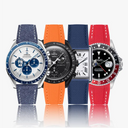
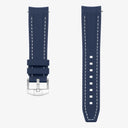
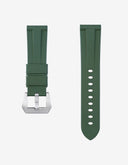
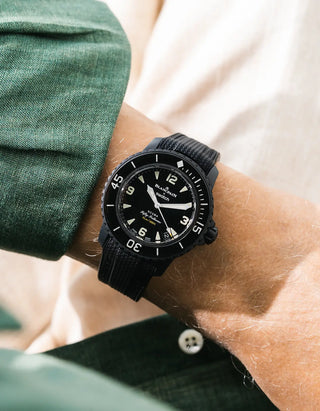
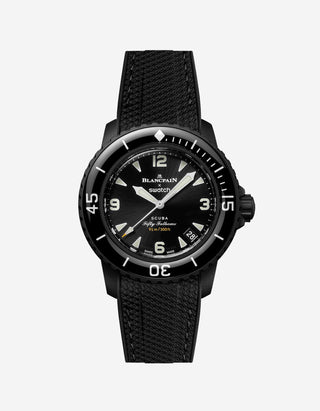
  The year of 2024 kicked off with a new launch within the collaboration between Swatch Group-owned Blancpain and Swatch. The collaboration has previously generated five models in different colours, and now it is finally time for one in black, the name is Ocean of Storms. Blancpain has a long tradition of watchmaking. In fact, their very first Fifty Fathoms was presented 70 years ago. The watch revolutionised the world by being the first modern diver's watch and it was designed by a passionate sport diver, Jean-Jacques Fiechter. Jacques Fiechter, who was the CEO of Blancpain at the time. The watch instantly became very popular with elite divers and underwater divers and underwater researchers, thanks to its favourable characteristics such as water resistance, double sealing of the crown, easy-to-read dark dials with good contrast to the luminescent detailing and the unidirectional rotating bezel. After launch, the watch could be seen in popular diving films and the German and French navies started using the watch, but it didn't stop there. The US Navy Seal's elite diving unit also discovered the watch and used it. Over the years, the Fifty Fathoms models have continued to enjoy a high status among professional underwater explorers and collectors. However, the brand has not been so well known to the average person in the world. The brand however got a real boost after they decided to make a similar collaboration with Swatch as Omega did with Moonswatch. And now this collaboration continues with the addition of a new colours to the collection.   Black in particular is a very smart and wise choice for them to make, simply because the previous models have a more playful colour scheme. A more playful colour scheme that is not so easy to wear for everyone, especially if you have a more sophisticated style. There was an absence of a more stylish version, which is why Ocean of Storms fits in very well as a hit on the market.    The black colour is inspired by the black moon and, in the same spirit as the other five models, the case is in Bioceramic. It´s material patented by Swatch and consists of two-thirds ceramic and one-third biosourced material derived from castor oil.   The watch has an automatic movement, SISTEM51, which is also found in their previous Blancpain X Swatch. This was developed by Swatch back in 2013 and consists of only 51 parts, hence the name. Another positive thing is that it has an anti-magnetic property thanks to its NivachronTM balance spring. It's fascinatingly how this mechanical movement is entirely assembled using automated assembly. This is in other words not assembeld by hand, all in the name of efficiency and cost reduction. The power reserve is 90 hours and has an open back where you can see the parts of the movement that are laser-decorated. Each model also has its own signature on the back and the new one's has an image of a neck snail called Okenia Luna.   The fact that the watch is water-resistant to 91 metres is not a coincidence, it is more than just a figure. It's a tribute to the name of the watch, Fifty Fathoms, where Fathoms historically means the the nautical measure of a depth and fifty fathoms is the equivalent of 91 metres.   The watch comes with a black nato strap with white stripes that contains recycled material from fishing nets and the pin buckle and pre-made holes are also made of black bioceramic like the the case is made of. If you want a more stylish and comfortable bracelet in a more uniform colour, Wristbuddys has a uniform of Blancpain Swatch straps in seven different colours. For example, the overall look of the watch can be enhanced with an all-black strap, or why not spice up your summer look with a bracelet in orange. Changing a bracelet for a certain outfit can do a lot for the overall look and with a black watch that is so stylish in itself, it becomes wonderfully sporty and elegant with a different Blancpain Swatch strap. The buckle is 304L stainless steel and the width of the rubber strap is 22 mm which moulds itself well and comfortably to the wrist. See our favorites for Ocean Of Storms collection below:    The Blancpain X Swatch Ocean of storms will be launched worldwide from 11 January, the day of the of the new moon, at selected Swatch stores. And precisely as with the five previous models in the Bioceramic Scuba Fifty Fathoms Collection, they are not limited in number but are limited to one watch per person, per store and per day.   BLANCPAIN X SWATCH OCEAN OF STORMSReference number: SO35B400Case material: Black BioceramicDiameter: 42.3 mmThickness: 14.4 mmDial: Black with sunburst finish, date at 4 & 5 o'clock. Superluminova on the hands, index and dive scale.Water resistance: 91 mStrap: NATOMovement: Mechanical movement SISTEM51Power reserve: 90 hoursWinding: AutomaticPrice: $400